Suite 245 4/16-18 Beenleigh-Redland Bay Rd
Loganholme QLD 4129
Australia
Student Handbook
1. Welcome
Thank you for choosing National Skills. We are a nationally registered training organisation (RTO 45438) committed to delivering high-quality vocational education and training. Whether you are pursuing a qualification through Recognition of Prior Learning (RPL) or completing a full course, our team is here to support you every step of the way.
This handbook provides you with the information you need to understand how your training works, what we expect from you, and what you can expect from us. Please read it carefully and keep it for reference throughout your enrolment.
2. About Us
2.1 Our Commitment to You
2.2 Regulatory Oversight
National Skills is regulated by the Australian Skills Quality Authority (ASQA) and operates in accordance with the Standards for Registered Training Organisations 2025. These standards set the quality expectations for training, assessment, student support, and governance across the Australian VET sector.
If you have a concern about any training provider, you can contact ASQA at www.asqa.gov.au or phone 1300 644 844.
3. Your Rights and Responsibilities
3.1 Your Rights
As a student of National Skills, you have the right to:
3.2 Your Responsibilities
As a student, you are responsible for:
4. Enrolment
4.1 Entry Requirements
Some courses have prerequisite requirements, such as prior qualifications or a minimum level of knowledge. Where entry requirements apply, they are published on the National Skills website under each course. If you are unsure whether you meet the requirements, please contact our team before applying.
4.2 Licence Requirements
If you are seeking a licence or occupational registration, check with the relevant licensing authority in your state or territory before enrolling. Licensing requirements vary between states and may require completion of specific units or the full qualification.
4.3 Pre-Training Review
Before you enrol, we conduct a pre-training review to assess your existing skills, experience, and language, literacy, numeracy, and digital literacy. This helps us determine whether the course is suitable for you, identify any support you may need, and discuss whether RPL or credit transfer may be appropriate.
4.4 Unique Student Identifier (USI)
You need a Unique Student Identifier (USI) to receive nationally recognised training in Australia. If you do not have one, you can apply at www.usi.gov.au. We will verify your USI during enrolment.
4.5 Identity Verification
We verify the identity of all students at enrolment. You will be asked to provide identification. Any requests for access to your student records (by phone or email) will require written verification.
5. Pathways to Qualification
National Skills offers several pathways to achieving a qualification. Your trainer will help you determine the most suitable pathway during the pre-training review.
5.1 Recognition of Prior Learning (RPL)
RPL assesses your existing skills and knowledge – gained through work experience, life experience, and prior training – against the requirements of a qualification. If you already meet the standard, you may receive credit without repeating the learning.
The RPL process involves:
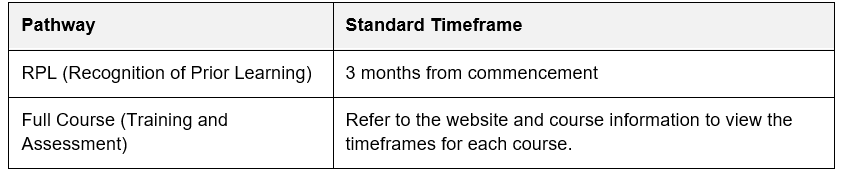
RPL Completion Timeframe: You have 3 months from the date your RPL assessment commences to complete the process, including submission of all required evidence and payment of all fees. If you need more time, you may apply for an extension (see Section 8.2).
5.2 Full Course
Full course students complete structured training and assessment for each unit of competency. This includes knowledge-based assessments (such as written questions, scenarios, and short answers) and performance-based assessments (such as practical tasks, workplace demonstrations, and portfolio evidence). Full course students have 12 months to complete.
5.3 RPL with Gap Training
If your RPL assessment identifies gaps – areas where your existing skills and knowledge do not yet meet the standard – you may be offered targeted gap training for those specific units. This combines RPL for the units you already meet with focused learning for the units you need to develop. If a large number of gap units are identified, your trainer may recommend enrolling in the full course.
Your access to the gap training units is issued once the final RPL payment has been received. You have another 3 months to complete your gap training once you have been assessed for the RPL component. If the 3 months lapses, and you have not applied for an extension, a statement of attainment will be issued to you for all the units deemed competent to date.
5.4 Credit Transfer
If you have already completed an equivalent unit of competency with another RTO, you may be eligible for credit transfer. To apply, provide your qualification, statement of attainment, or authenticated VET transcript. Credit transfer decisions are documented and communicated to you in writing.
6. How Assessment Works
6.1 Competency-Based Assessment
National Skills uses competency-based assessment. This means you are assessed on whether you can demonstrate the skills and knowledge required by the training product to the standard expected by industry. There are only two outcomes:
Result What It Means
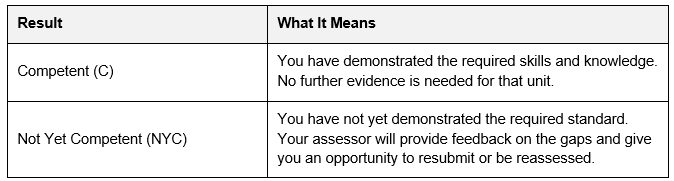
A result of Not Yet Competent is not a failure. It means there are specific areas to address, and you will be supported to improve and try again.
6.2 Principles of Assessment
All assessment is conducted in accordance with these principles:
6.3 Rules of Evidence
Your assessor evaluates your evidence against four rules:
6.4 Types of Assessment
Assessment may include:
Evidence you submit may include workplace documents (authorised by a supervisor), photos, videos, employer references, sample work, or completed tasks.
6.5 Submitting Your Work
6.6 Academic Integrity
Plagiarism – presenting someone else’s work, ideas, or output as your own without proper acknowledgement – is a serious breach. This includes copying from published sources, submitting another person’s work, or using AI-generated content without disclosure. Academic misconduct may result in a Not Yet Competent result, a formal warning, or in serious or repeated cases, cancellation of enrolment.
Always express your understanding in your own words. When you draw on external sources, reference them clearly.
7. Support Services
7.1 Your Trainer and Assessor
Your trainer is your primary point of contact throughout your enrolment. They are available to help with:
We encourage you to maintain regular contact with your trainer. Experience shows that students who communicate proactively and build a rapport with their assessor achieve the best outcomes. If you are unsure about something, finding it difficult to get started, or need guidance at any point – reach out. That is what your trainer is here for.
7.2 How to Contact Us
You can contact your trainer directly or reach our team through:
7.3 Reasonable Adjustments
If you have a disability, learning difficulty, or any other circumstance that may affect your ability to participate in training and assessment, please let us know – ideally during the pre-enrolment process. National Skills will work with you to make reasonable adjustments so that you can participate on an equal basis. All information about your needs is treated confidentially.
7.4 Wellbeing Support
Your wellbeing matters to us. National Skills identifies the wellbeing needs of its student cohorts and puts strategies in place to support them, as set out in the Student Wellbeing Policy. We train our staff to recognise signs of distress and to respond sensitively. If you are experiencing personal challenges that affect your ability to study – whether related to mental health, financial hardship, family circumstances, disability, or cultural safety – we encourage you to speak with your trainer or any member of staff. You do not need to manage it alone. We can provide information about external support services, including:
7.5 Language, Literacy, Numeracy, and Digital Literacy
If you need additional support with reading, writing, numeracy, or using digital technology, let us know. We can provide assistance or refer you to appropriate support services. Your training may require you to use an online portal, access digital resources, and submit work electronically, so it is important to let us know early if you need help with these skills.
8. Fees and Payment
Each course has a published total fee, which is the maximum amount chargeable. All advertised fees are all-inclusive. Course fees are listed on the National Skills website and are confirmed by email before enrolment.
A deposit is required prior to commencement. RPL applications follow a two-stage payment schedule. Full details of all fees, payment terms, and refund entitlements are set out in the Refund and Fee Protection Policy and the Course Fee Schedule, available on request or on our website.
There are no fees for re-submission, re-assessment, or withdrawal. A Statement of Attainment for partially completed units is issued at no additional charge. Fees apply for replacement certification and hard copy certificates – see the Course Fee Schedule for details.
All fees paid in advance are held in a separate account until training commences, protecting your funds in accordance with the Standards for RTOs 2025.
National Skills reserves the right to review and amend course fees at its discretion. Where fees change, the new fee applies to new enrolments and to replacement qualifications. The fee agreed at your enrolment applies to the qualification you are enrolled in, unless you transition to a replacement qualification, in which case Section 11.2 applies. We will give you written notice of any fee change that affects you before it takes effect.
9. Course Progress and Timeframes
9.1 Staying on Track
Regular engagement is essential. We expect you to maintain contact with your trainer and make consistent progress. If we do not hear from you for an extended period, we will reach out. If there is no response or activity after our contact attempts, your enrolment may be cancelled and fees may will be forfeited according to our Refund Policy.
9.2 Extensions
If you are unable to complete within the standard timeframe, you may apply for an extension in writing. Extension requests are assessed by management and will attract additional fees. Extensions will be granted at the discretion of the management team and are not guaranteed. You may be asked to provide a plan with milestones for completion. Multiple requests without evidence of progress will be declined.
9.3 Course Hold or Deferral
If unforeseen circumstances prevent you from continuing your module, you may request a temporary hold for up to three months. Requests must be submitted in writing with supporting documentation (such as a medical certificate) and must include your full name, course name and code, the reason for the request, and any supporting documents. Deferrals will be granted at the discretion of the management team and are not guaranteed.
9.4 Withdrawal
If you wish to withdraw, notify National Skills in writing. A Statement of Attainment will be issued for any units you have completed. For refunds, refer to the Refund Policy for full details.
10. Results and Certification
10.1 Assessment Feedback
Your assessor will provide constructive feedback on each assessment marked Not Yet Competent or Not Yet Satisfactory. If you receive a Not Yet Competent or Not Yet Satisfactory result, your assessor will explain the gaps and provide direction on what is needed. You will be given an opportunity to address the feedback and resubmit or be reassessed. If you receive feedback that is unclear, contact your trainer to discuss it further.
10.2 Issuance of Qualifications
Qualifications and Statements of Attainment are issued within 30 days of being assessed as competent in all required units, provided all fees have been paid and a valid USI has been provided. National Skills aims to issue certificates within 21 days. Certificates are issued electronically.
10.3 Nationally Recognised Qualifications
All qualifications issued by National Skills are nationally recognised under the Australian Qualifications Framework (AQF). This means your qualification is recognised by employers, licensing bodies, and other training organisations across Australia.
11. Changes That May Affect You
National Skills will inform you as soon as practicable of any changes to your course or our operations that may affect you. This includes changes relating to the transition of superseded, deleted, or expired training products that you are currently enrolled in.
11.1 Transitioning to a New Qualification
Qualifications are periodically updated, superseded, or removed on the national register (training.gov.au). When this happens, a transition period applies — generally 12 months. Within that period we will either complete you in your current qualification (where you can finish in time) or transition you to the replacement qualification. We will recognise units you have already completed that remain equivalent, so you are not assessed again unnecessarily.
11.2 Fees on Transition
A replacement qualification may contain additional or different units of competency and may have a higher fee than the qualification you enrolled in. Where you transition to a replacement qualification, National Skills reserves the right to charge the difference between the fee you have already paid and the current fee for the replacement qualification, including the cost of any additional units. We will give you written notice of any difference, and the amount payable, before the transition takes effect. Continuing in the replacement qualification is conditional on accepting the transition and paying, or agreeing to a payment arrangement for, the difference. If you do not wish to transition and cannot complete within the transition period, your enrolment will be managed under the Refund Policy.
12. Third-Party Arrangements
In some cases, National Skills may engage a third party to assist with the delivery of training, assessment, or support services. Where this applies to your course, you will be informed before enrolment about which services are delivered by a third party, the identity and role of that third party, and how to access support and lodge complaints. National Skills remains responsible for the quality of all services delivered on its behalf.
13. Complaints and Appeals
13.1 Providing Feedback
National Skills welcomes your feedback at any time. If you have a concern, raise it with your trainer or any staff member in the first instance. Many issues can be resolved through a simple conversation.
13.2 Making a Complaint
If a concern cannot be resolved informally, you may lodge a formal complaint in writing. Your complaint will be acknowledged within 5 business days and we aim to resolve it within 20 business days. You will be kept informed of progress. Full details are in the Complaints and Appeals Policy.
13.3 Appealing a Decision
If you disagree with an assessment result or any other decision that adversely affects you, you may lodge a written appeal within 20 business days of being notified. Your appeal will be reviewed by someone not involved in the original decision. If you are not satisfied with the outcome, you can lodge a complaint in writing and address it to management at National Skills.
13.4 External Bodies
If your complaint or appeal is not resolved to your satisfaction, you may contact:
14. Student Code of Conduct
As a student, you are expected to:
Breaches of the code of conduct may result in counselling, a formal warning, suspension, or cancellation of enrolment. You will be given a fair opportunity to respond before any action is taken.
Vilification, including racial or religious vilification and antisemitism, is treated as a serious breach under the Anti-Vilification Policy and Code of Conduct and may result in immediate suspension. In cases of violent, threatening, or seriously disruptive behaviour, or where a person is under the influence of banned substances, National Skills reserves the right to remove the student immediately.
15. Privacy and Confidentiality
15.1 Your Personal Information
All personal information you provide is managed in accordance with the Privacy Act 1988 (Cth) and the Australian Privacy Principles. Only staff with a legitimate need will access your information. It will not be disclosed to third parties without your written consent, except where required by law or for regulatory reporting (such as AVETMISS reporting to NCVER).
15.2 Our Training Materials
All training materials and resources provided by National Skills are confidential and proprietary. They are for your personal educational use only and must not be copied, shared, uploaded to document-sharing sites, or distributed without written permission. Unauthorised distribution will be pursued under intellectual property laws.
15.3 Your Student Records
Your enrolment details, assessment results, and certification records are stored securely. Assessment evidence is retained for a minimum of two years from completion (for training products completed on or after 1 July 2025). You have the right to request access to your records by providing proof of identification. We recommend that you keep a personal copy of all assessment work you submit. Refer to the Privacy and Confidentiality Policy for more information.
16. Access, Equity and Inclusion
National Skills is committed to providing training that is fair and accessible for all. We foster a safe, inclusive, and culturally safe learning environment. All students have equal access to our programs regardless of gender, cultural or linguistic background, race, disability, age, marital status, pregnancy, sexual orientation, or caregiving responsibilities.
We recognise the unique position of Aboriginal and Torres Strait Islander peoples as the First Nations people of Australia, and are committed to providing a culturally safe learning environment for First Nations students.
National Skills maintains a zero-tolerance approach to vilification in any form, including racial vilification, religious vilification, and antisemitism. All students and staff are entitled to participate in training in an environment free from vilification and intimidation. Cultural, religious, and linguistic diversity is valued and respected. Full details of expected and prohibited behaviours are set out in the Anti-Vilification Policy and Code of Conduct.
If you have any questions or concerns about access and equity, please contact us. Please refer to the Access Diversity and Inclusion Policy for more information.
17. Work Health and Safety
National Skills maintains a safe learning and working environment. Your cooperation is essential. You are expected to:
If a risk is identified during any activity, the activity will be stopped until the risk is addressed. Refer to the Work Health and Safety Policy.
18. Modes of Delivery
National Skills delivers training through a range of methods, depending on the course and your circumstances:
The mode of delivery for your course will be confirmed at enrolment. Regardless of the delivery method, you will have access to your trainer for support throughout your enrolment.
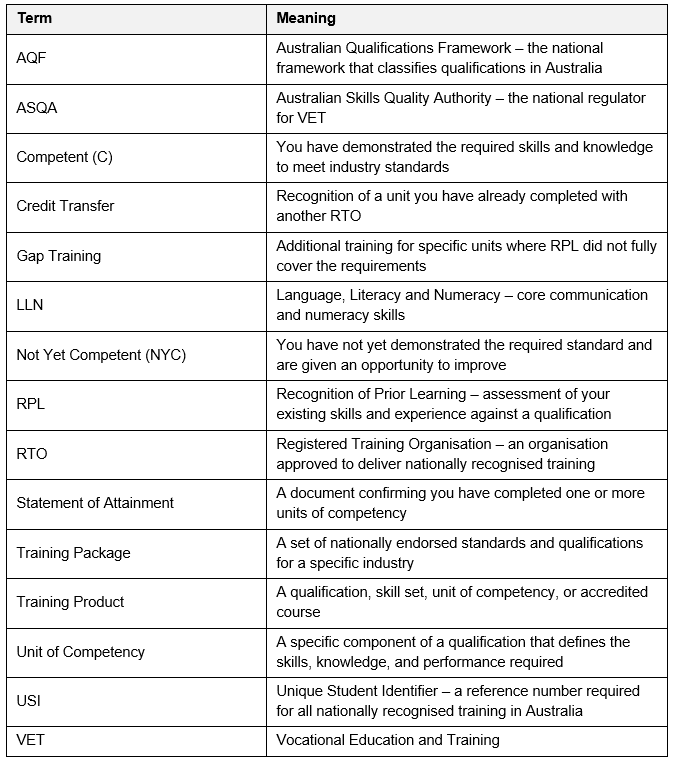
19. Glossary of Key Terms
20. Key Contacts
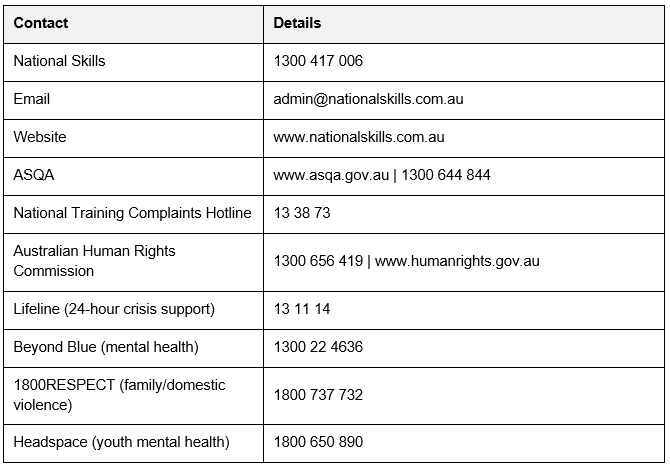
21. Related Policies and Procedures
This handbook provides a summary of key information. Full details are in the following documents, available on request or on our website:
22. Legislative Framework
National Skills operates in accordance with all applicable Australian legislation, including:
Current legislation is available at www.legislation.gov.au.
You can download the Student Handbook here.